


Large-Flange Blind Rivet for Soft & Brittle Materials · Aluminium · 4.0 mm & 4.8 mm · Wide Grip Range
 Resists pull-out and cracking the work piece
Excellent for brittle and soft materials like plastics
Extra large secondary head provides more bearing surface
With the wide spreading tail, this rivet has a greater tolerance of oversized holes and offer a wide grip range
Wood
Insulation
Plastic
Plastic Boards
Resists pull-out and cracking the work piece
Excellent for brittle and soft materials like plastics
Extra large secondary head provides more bearing surface
With the wide spreading tail, this rivet has a greater tolerance of oversized holes and offer a wide grip range
Wood
Insulation
Plastic
Plastic Boards
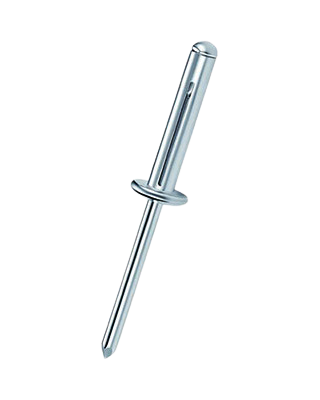

Aluminium
Bulb Tite blind rivets are available in aluminium alloy only, in two body diameters. Note the hole size is larger than a standard blind rivet of the same diameter — this is intentional, as the three-leg bulb needs room to expand into its characteristic wide-bearing head. Always use the hole size specified below.
A standard blind rivet forms a single round dome on the blind side when set. That dome concentrates all the clamping force on a small circular area — which is fine for metal, but causes pull-through, cracking or tearing in soft materials like plastic boards, wood composites and insulation panels. The Bulb Tite rivet solves this by forming three outward-spreading legs that open into a wide, lantern-shaped bulb on the blind side. This dramatically increases the bearing area, spreading the clamping load across a much larger surface and making pull-through virtually impossible even in low-density or brittle substrates.
Single dome blind head
Forms a single compact dome on the blind face. Bearing area is limited to the diameter of the rivet body — approximately the same as the hole size. On metals this is sufficient; on plastics, insulation or wood, this concentrated force can crack the panel or pull clean through the hole under load.
Small bearing area — concentrated load
Three-leg expanding bulb head
Three pre-formed legs fold outward during setting, creating a wide lantern-shaped bulb 2–3× the diameter of the rivet body. This large bearing surface distributes the clamping force evenly across the substrate — preventing pull-through and surface cracking in wood, plastic, gypsum and insulation materials.
Wide bearing area — distributed load
Wood & Ply
Plywood, MDF, particleboard, timber frames
Gypsum Board
Drywall panels, plasterboard, ceiling tiles
Plastics
ABS panels, PVC boards, polycarbonate sheets
Insulation
Foam boards, mineral wool panels, composite insulation
Drill to the larger hole size specified for the Bulb Tite — 4.2–4.5 mm for the 4.0 mm rivet, or 5.0–5.25 mm for the 4.8 mm. The wider hole allows the three legs to fold outward cleanly during setting.
Insert the rivet body through the hole from the accessible side. The flange head sits flat against the face of the material. Load the mandrel stem into a standard blind rivet gun — no special tooling required.
As the mandrel is pulled, the three pre-scored legs on the blind end fold outward and spread into a wide, even bulb. The legs bear against the underside of the substrate across a much larger area than a standard rivet dome.
The mandrel breaks at the set point and is ejected. The completed joint has a neat flange head on the top face and the characteristic three-legged bulb on the blind face — clamping the material firmly without any surface cracking or pull-through.
4.0 / 4.8
Diameters (mm)
3 Legs
Expanding Blind Head
12 mm
Max Grip Range
Aluminium
Body Material
A standard rivet forms a small dome blind head that concentrates all clamping force on a tiny area. In soft or brittle materials like plastic, wood composites or gypsum board, this concentrated load often cracks the panel around the hole or pulls clean through under stress. The Bulb Tite's three-leg expanding head spreads that same force over a much wider bearing area, eliminating both failure modes.
No. The Bulb Tite uses a standard mandrel stem and works with any hand or pneumatic rivet gun that accepts 4.0 mm or 4.8 mm nosepieces. There is no special tooling requirement — which makes it a practical drop-in upgrade from standard rivets on any job involving soft materials.
The three legs on the blind end of a Bulb Tite rivet need clearance to fold outward during setting. If the hole is too tight, the legs cannot open fully and the bulb head will not form correctly. Always use the hole size specified for the Bulb Tite — not the standard rivet hole size chart.
The standard Bulb Tite (BT) is available in aluminium alloy only. Aluminium is the correct choice for the soft and non-metallic materials this rivet is designed for — it is lightweight, non-magnetic and galvanically compatible with composite and plastic panels. For heavy structural applications on steel, consider the open end steel blind rivet instead.
Yes — the Bulb Tite is one of the few blind rivets that performs reliably on gypsum board and drywall. The wide three-leg head distributes the load far beyond the fragile hole edge, preventing the crumbling or cracking that standard rivets typically cause on plasterboard. It is used extensively in partition wall systems, false ceiling framing and drywall panel assembly across India.

 Home
Home
 About Us
 Products
 Contact Us


