Mechanical anchors for concrete, masonry and hollow substrates — wedge, drop-in and wall plug. Trusted by contractors and fabricators across India.
A mechanical anchor creates a secure fixing point in a pre-drilled hole in concrete, masonry or block by mechanically expanding or gripping against the substrate — as opposed to a chemical anchor, which relies on injected resin adhesive. Mechanical anchors are the standard choice wherever the substrate is solid enough to expand against, installation speed matters, and there is no wait time for adhesive cure.
The correct anchor type depends on three things: the substrate (solid concrete, hollow block, brick, drywall), the load direction and magnitude the fixing must carry, and whether the fixture needs to be removable or is permanent. Getting any of these wrong is the most common cause of anchor failure on site.
Excel Trading Corporation stocks wedge anchors, drop-in anchors and wall plug anchors — covering the large majority of general construction, mechanical and electrical fixing applications.
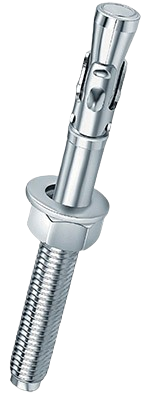
An externally threaded stud with an expansion clip at the embedded end. As the nut is tightened, the clip is drawn up a tapered wedge, expanding tightly against the sides of the drilled hole. The stud remains exposed for a fixture to be bolted on afterward — the standard choice for structural steel base plates, racking and machine mounting into solid concrete.
Also known as: Expansion Bolt, Stud Anchor
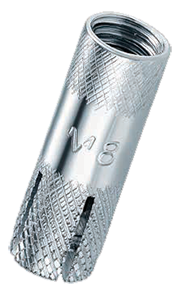
An internally threaded sleeve that is inserted into the hole and expanded flush with the surface using a setting tool and hammer — before the fixture is bolted in. Because it sits flush and is internally threaded, it gives a clean finish and can accept a bolt that is later removed and reinstalled without losing the fixing point.
Also known as: Internally Threaded Anchor
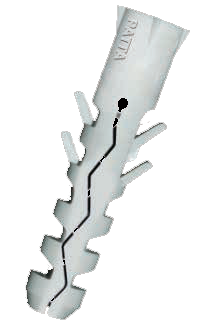
A light-duty plastic or nylon sleeve that expands as a self-tapping screw is driven into it, gripping the sides of the hole in masonry or brick. The most common household and light commercial fixing for shelving, brackets and fixtures where structural loads are not involved.
Also known as: Rawl Plug, Fischer Plug
Important Selection Rule
Never assume — always confirm the anchor's rated pull-out and shear load against your actual application load, including a safety factor. Anchor capacity depends on hole diameter, embedment depth, edge distance, spacing between anchors and the compressive strength of the concrete itself. When in doubt, ask us for the specific product datasheet before specifying.
Unlike chemical anchors, mechanical anchors reach full rated capacity as soon as they are correctly torqued — no waiting for adhesive to cure before loading the fixture.
Drill, clean the hole, insert and tighten or set — no mixing, no dispensing gun, no shelf-life concerns with adhesive cartridges.
Mechanical anchor performance is consistent and can be verified by torque or pull testing immediately after installation.
Lower cost per fixing than chemical anchor systems for the majority of general construction and mechanical fixing applications.
Available across a wide diameter and length range to suit everything from light shelving brackets to structural steel base plates.
Zinc plated as standard, with stainless steel options available for outdoor, coastal and washdown environments.
Drill the exact hole diameter specified: Undersize and the anchor won't seat; oversize and expansion capacity drops sharply. Match the drill bit to the anchor manufacturer's stated diameter, not the nominal thread size.
Clean the hole thoroughly: Blow or vacuum out drilling dust before inserting the anchor. Dust left in the hole is the single most common cause of reduced pull-out strength.
Achieve full embedment depth: The anchor must be driven or set to the minimum depth specified — a shallow-set anchor has dramatically lower holding capacity.
Respect minimum edge distance and spacing: An anchor placed too close to a concrete edge or to another anchor can cause the concrete to break out under load, well below the anchor's rated capacity.
Torque wedge anchors to the specified value: Undertightening leaves the wedge clip under-expanded; overtightening can shear the stud. Use a calibrated torque wrench for structural applications.
Never load beyond the rated capacity: Always apply an appropriate safety factor and confirm the anchor's tested pull-out and shear values against your actual design load.
A mechanical anchor creates a secure fixing point in concrete, masonry or another solid substrate by mechanically expanding or gripping against the sides of a pre-drilled hole. Unlike a chemical anchor, which relies on adhesive, a mechanical anchor achieves its holding power purely through friction and mechanical interlock as it is tightened or driven.
A wedge anchor is externally threaded — the stud protrudes and a nut is fitted over it, expanding a clip at the embedded end as it is tightened. It suits fixtures installed after the anchor. A drop-in anchor is internally threaded and sits flush — it is set with a setting tool before the fixture is bolted in, giving a clean, low-profile finish suited to removable fixings.
A wall plug is designed primarily for masonry, brick and lighter density substrates. It can be used in solid concrete for light-duty fixings, but for structural or higher-load applications in concrete, a wedge anchor or drop-in anchor is the correct choice.
Minimum embedment depth and edge distance vary by anchor diameter and the manufacturer's tested values — using less than the specified minimum significantly reduces pull-out and shear capacity. Always refer to the specific anchor's technical datasheet rather than estimating.
Drilling dust left in the hole reduces the expansion clip's grip against the concrete wall, directly reducing the anchor's holding capacity. Blow or vacuum the hole clean before inserting the anchor — this is one of the most common causes of anchor pull-out failure on site.
Excel Trading Corporation stocks wedge anchors, drop-in anchors and wall plug anchors at our store — 163, Sadar Patrappa Rd, Kumbarpet, Bengaluru 560002. We supply across Karnataka and India. Call +91 7204435253 or email info@exceltrading.in for pricing and availability.