Self tapping screws to DIN 7981 and DIN 7982 — pan, countersunk, truss and hex flange head. Trusted by sheet metal fabricators, electronics enclosure manufacturers and general industry across India.
A self tapping screw cuts or forms its own internal mating thread as it is driven into a pre-drilled pilot hole. The sharp, gimlet-shaped point starts the thread engagement, and the coarse, deep thread profile cuts through the material as the screw is driven — creating a tight mechanical joint without a separate nut. Self tapping screws in India and globally are manufactured to DIN 7981 (pan head) and DIN 7982 (countersunk head), with pozidriv and slotted drive variants covered under DIN 7983 and DIN 7972/7973.
Unlike a self drilling screw, a self tapping screw cannot drill its own hole — the point is only sharp enough to locate and start the thread, not to cut through solid metal. This makes correct pilot hole sizing the single most important factor in a reliable self tapping joint: too small and the screw will be difficult to drive and may shear; too large and thread engagement — and therefore pull-out strength — drops sharply.
They are the standard fastener for thin sheet metal, plastics, electronics enclosures and general fabrication wherever a pilot hole is already punched or drilled as part of the manufacturing process.
Self tapping screws are manufactured to DIN 7981 (pan head, Type C coarse thread) and DIN 7982 (countersunk head, Type C coarse thread), with truss and hex flange head variants covering specialised applications. Getting the pilot hole right is the difference between a strong joint and a stripped, spinning screw.
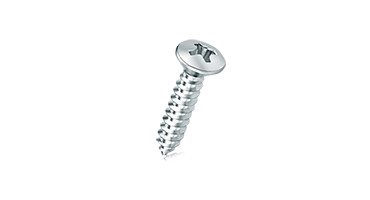
General-purpose head with a large, positive drive recess. Sits proud of the surface. The most commonly stocked self tapping screw for sheet metal fabrication.
Also known as: Pan Head Tapping Screw
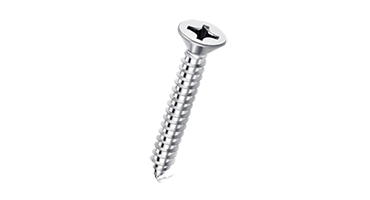
90° countersunk head for a flush, level finish. Used wherever the fastener head must not protrude — enclosure lids, panels and visible surfaces.
Also known as: CSK Head Tapping Screw
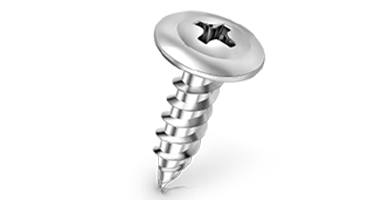
Extra-wide, low-profile domed head that spreads clamping load over a larger bearing area — the preferred choice for polycarbonate sheet, fibre sheet and other materials where pull-through is a risk.
Also known as: Wide Head Tapping Screw
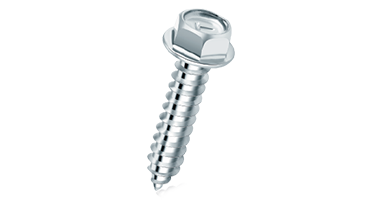
Hexagonal head with an integral flange that acts as a built-in washer, driven with a socket or nut driver for significantly higher driving torque than a Phillips recess. Common in sheet metal, HVAC, cladding and heavier fixings.
Also known as: Flanged Hex Head Tapping Screw, Hex Washer Head Tapping Screw
The pilot hole should be close to the screw's minor (root) thread diameter — large enough to allow the screw to enter without excessive driving torque, small enough that the thread fully engages the material for maximum pull-out strength. Use the table below as a general starting point; always confirm against the specific screw's datasheet and the hardness of your material.
Plastic Applications Need a Different Rule
For plastic enclosures and mouldings, the pilot hole is sized against the plastic supplier's boss design guide, not the sheet metal table above — plastics need a larger hole relative to screw diameter to prevent hoop stress cracking, and a coarser, shallower thread engagement is normal. Contact us for the correct sizing on your specific plastic and wall thickness.
The coarse thread profile cuts a full mating thread directly into the parent material — no separate nut required, and the joint resists loosening better than a smooth-shank fastener.
Because the pilot hole is drilled separately and to a controlled size, thread engagement is consistent and repeatable — important for high-volume production where every fastener must perform identically.
Unlike self drilling screws, self tapping variants are gentle enough — with the right pilot hole — for plastics, fibre sheet and other materials that would crack under a drilling action.
Pan, countersunk, truss and hex flange head options let you match the fastener to the finish and bearing area your application needs.
Where pilot holes are already part of the manufacturing process (stamped or laser-cut sheet), self tapping screws are the most economical fastening method available.
Available in white zinc plated and stainless steel A2/A4 finishes for indoor, outdoor and coastal applications.
Drill the pilot hole to the correct diameter: Too small causes excessive driving torque and possible screw shear; too large reduces thread engagement and pull-out strength.
Deburr the hole: Remove burrs from both sides of the pilot hole before driving — a burr prevents the head from seating flush and can cause cross-threading.
Drive perpendicular to the surface: Angled entry causes uneven thread engagement and reduces pull-out and shear strength significantly.
Do not overtighten: Stop once the head seats firmly against the surface. Continuing to drive strips the cut thread, especially in thin sheet or plastic.
For plastics, use low driver speed: High-speed driving generates friction heat that can melt or crack rigid plastics around the boss.
Use the correct bit: A worn or wrong-sized driver bit causes cam-out, which strips the drive recess before the fastener is fully seated.
Self tapping screws require a pre-drilled pilot hole — the sharp point starts the thread but cannot drill through metal. Self drilling screws have a built-in drill-bit tip and need no pilot hole. Self tapping is the right choice for thin sheet, plastics, and wherever a hole is already punched; self drilling is faster for metal-to-metal work with no pre-drilling step.
For sheet metal, the pilot hole should be close to the screw's minor thread diameter — see the sizing table above for common No. 6 to No. 12 screws. For plastics, follow the specific material supplier's boss design guide, since plastics need a larger relative hole to avoid stress cracking.
Pan head is the general-purpose default. Countersunk (DIN 7982) gives a flush finish. Truss head suits soft or brittle materials like polycarbonate where pull-through resistance matters most. Hex flange head is used where higher driving torque or field assembly with a spanner is required.
A self tapping screw can generally be removed and re-driven into the same hole a limited number of times before thread wear reduces holding strength. For assemblies that will be disassembled and reassembled repeatedly, a threaded insert (such as an insert press nut) is a more durable solution.
Excel Trading Corporation stocks self tapping screws in white zinc plated mild steel as standard, with stainless steel A2 (SS304) available for outdoor and corrosive environments. Confirm your material requirement with us before ordering for coastal or washdown applications.
Excel Trading Corporation stocks pan head, countersunk, truss head and hex flange head self tapping screws at our store — 163, Sadar Patrappa Rd, Kumbarpet, Bengaluru 560002. We supply across Karnataka and India. Call +91 7204435253 or email info@exceltrading.in for pricing and availability.