Click your industry to see where sealed blind rivets are used.
What is a sealed blind rivet, and is it the same as a closed end blind rivet?
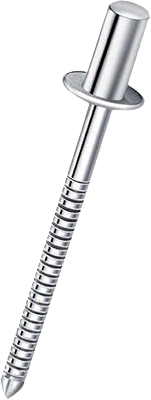
Yes, they are the same fastener. A sealed or closed end blind rivet has a cup-shaped closed end on the blind side. When the mandrel is pulled it breaks off inside the rivet body and the closed end stays intact, so the rivet leaves no open hole through it. It is installed from one side only, like any blind rivet.
How is a sealed rivet different from an open end (standard pop) rivet?
An open end rivet leaves a hole through the centre of the set rivet where the mandrel stem breaks off. A sealed rivet keeps the broken mandrel captive inside a closed end. That helps keep moisture, dust and air out of the joint and the mandrel head cannot fall out or rattle. The retained mandrel typically also gives higher shear and tensile strength than a comparable open end rivet of the same diameter and material.
Is a sealed blind rivet waterproof?
It helps seal the joint, because the closed end blocks the hole through the rivet. It is not a pressure or immersion seal on its own. The sheets still meet at the rivet head and between the sheets, so for a fully watertight or airtight joint use a sealant or gasket between the sheets as well.
Which material should I choose: aluminium/steel, steel/steel, stainless steel or aluminium/aluminium?
Aluminium body with a steel mandrel (aluminium/steel) is the most common choice for general sheet, vehicle bodywork and enclosures. Steel/steel gives the highest strength for steel fabrication. Stainless steel A2/A2 has both the body and the mandrel in A2 stainless, so it resists corrosion and avoids mixed-metal corrosion, which suits outdoor, marine and food applications. Aluminium/aluminium is the lightest and is galvanically compatible with aluminium sheet, but has the lowest strength. We supply all four.
Which head style do I need, dome or countersunk?
The dome head is the standard choice. It sits proud of the surface and gives the widest bearing area. A countersunk head sits flush with the surface when set into a countersunk or dimpled hole, which suits visible panels where a smooth finish matters. Tell us which you need when you enquire.
What hole size and rivet length do I need?
Drill the hole slightly larger than the rivet body: 2.5 to 2.6 mm for a 2.4 mm rivet, 3.3 to 3.4 mm for 3.2 mm, 4.1 to 4.2 mm for 4.0 mm, 4.9 to 5.0 mm for 4.8 mm and 6.5 to 6.6 mm for 6.4 mm. The correct length depends on the total thickness of the sheets being joined. Tell us the diameter, material and the total sheet thickness and we will confirm the right rivet.
Where are sealed blind rivets used?
They are used in coach and vehicle body work, shipping containers and enclosures, air conditioning and HVAC units, and ship building and cladding, wherever a one-sided fastener is needed and the joint should be sealed against moisture and dust.
Where can I buy sealed blind rivets in Bangalore?
Excel Trading Corporation supplies sealed (closed end) blind rivets in 2.4, 3.2, 4.0, 4.8 and 6.4 mm, in aluminium/steel, steel/steel, stainless steel A2/A2 and aluminium/aluminium, with dome or countersunk heads, from our Kumbarpet office in Bengaluru to customers across Karnataka and India. Call +91 7204435253 or email info@exceltrading.in with your diameter, material and quantity.