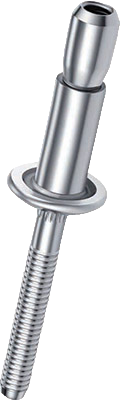
Anlock-In Bolt Blind Rivet is a structural blind rivet engineered for joints that demand more than a standard open-end rivet can deliver. It is designed specifically for assemblies subject to continuous vibration, high shear loads or demanding service conditions — truck chassis, automotive body panels, container floors, construction equipment and heavy fabrications.
What distinguishes it from a conventional blind rivet is its locking mandrel. In a standard rivet, the mandrel fractures at a pre-set break point and the remaining stub is held loosely inside the rivet body by friction alone. Under vibration, this stub gradually works free and can fall out — leaving an unfilled hole through the rivet body and a dramatic reduction in joint strength.
It eliminates this failure mode. At the set point, the mandrel head mechanically locks inside the rivet body. The stem breaks above the locked head, but the head itself is permanently captured — it cannot rattle loose, cannot fall out, and continues to contribute axial load-bearing strength to the joint throughout the service life of the assembly. Excel Trading Corporation stocks Anlock-In Bolt in steel, stainless steel and aluminium for projects across Bangalore and India-wide.
Standard Anlock-In Bolt Blind Rivet sizes stocked at our Bengaluru store. Grip range is the total material stack thickness the rivet will correctly clamp — select a rivet whose grip range covers your combined sheet thickness. Drill the hole to the exact diameter below; do not use a larger bit.
Standard Structural Grade
Highest shear and tensile strength of all three materials. Zinc plating provides corrosion protection in indoor and semi-exposed conditions. The standard choice wherever maximum mechanical performance matters — truck chassis, container fabrication, construction steel framing and heavy automotive assemblies.
Best for: Truck building · Containers · Construction · Structural steel
300-Series · Passivated
Fully corrosion resistant in outdoor, marine and coastal environments. Retains the locked mandrel performance in wet and salt-spray conditions. Slightly lower shear strength than steel but far superior long-term durability outdoors. Passivated finish compatible with food-grade and hygienic panels.
Best for: Outdoor equipment · Coastal structures · Food processing · Marine
5000-Series Alloy · Non-Magnetic
Significantly lighter than steel — the best option where weight reduction is a design priority. Non-magnetic and galvanically compatible with aluminium host panels. Used in vehicle bodywork, lightweight structural frames and aerospace brackets. All the benefits of the locking mandrel design at lower weight.
Best for: Automotive body panels · Lightweight vehicles · Aluminium fabrication
Drill or punch a clean hole to the exact diameter for your rivet size — see the size table above. Do not use a larger drill; even 0.2mm extra significantly reduces clamp-up force and can cause a sloppy installation.
Insert the rivet body through the hole from the accessible side. The rivet head should sit flush against the material face. Place the rivet gun nose squarely over the mandrel stem, fully seated.
Squeeze the rivet gun trigger or handles. As the mandrel is pulled, the rivet body expands on the blind side, forming a wide tail that clamps the material stack together with high continuous force.
At the set point the mandrel head locks mechanically inside the rivet body. The tool releases automatically. The result is a fully locked two-piece assembly — no loose stub, no unfilled hole, no future vibration loosening.
The grip range is the most important selection variable when specifying a blind rivet. Choosing a rivet with the wrong grip range results in either an overformed blind tail (grip too short — the rivet is crushed before it fully expands) or an underformed tail (grip too long — the rivet body never reaches its full expansion diameter). Both failures dramatically reduce joint strength.
Three rules for correct Anlock-In Bolt selection
Unsure which size to order? Call us on +91 7204435253 and we will specify the right rivet for your application.
Anlock-In Bolt is a structural blind rivet with a locking mandrel. After installation the mandrel head locks mechanically inside the rivet body instead of fracturing and leaving a loose stub. This creates a two-piece locked assembly with significantly higher shear and tensile strength than a standard open-end blind rivet and far better vibration resistance. It installs from one side only using any standard blind rivet gun — no special tooling is required.
A standard open-end blind rivet leaves a fractured mandrel stub held inside the rivet body by friction only. In assemblies subject to vibration — truck chassis, automotive body panels, containers, construction equipment — this stub works loose progressively, eventually falls out, and leaves an unfilled hole through the rivet body with severely reduced shear resistance. The Anlock-In Bolt locks the mandrel head permanently inside the body at the moment of installation. The mandrel cannot loosen because it is mechanically captured — not friction-held. This is what makes it a structural rivet suitable for high-vibration applications where a standard rivet would progressively fail.
Steel (zinc plated for indoor and semi-exposed environments), stainless steel (300-series passivated for outdoor and marine use) and aluminium alloy (for lightweight structural panels and vehicle bodywork). Steel gives the highest shear strength. Stainless steel gives the best corrosion resistance. Aluminium gives the lowest weight. All three retain the locking mandrel performance that distinguishes the Anlock-In Bolt from a standard rivet.
Measure the total combined thickness of all the material layers the rivet passes through. Select a rivet whose grip range includes that measurement. For example, joining a 3mm steel angle bracket to a 2mm panel (total 5mm stack) requires a rivet with a grip range that covers 5mm. Using a rivet with a grip range that does not include your stack will result in a poorly formed blind tail and a weak joint. Always drill the hole to the exact diameter specified for your rivet — oversize holes reduce clamp-up significantly.
Yes. An Anlock-In Bolt installs with any standard pneumatic or manual blind rivet tool compatible with the rivet diameter. No special adapters, settings or tools are required. The locking action happens automatically at the point of set — the tool releases when the mandrel locks, providing a clear tactile indication of a correct installation.
Excel Trading Corporation stocks Anlock-In Bolt blind rivets in steel, stainless steel and aluminium at our Kumbarpet store in Bengaluru. We supply across Karnataka, Tamil Nadu, Andhra Pradesh, Telangana and India-wide. Call +91 7204435253 or email info@exceltrading.in for pricing, availability and bulk quotes.