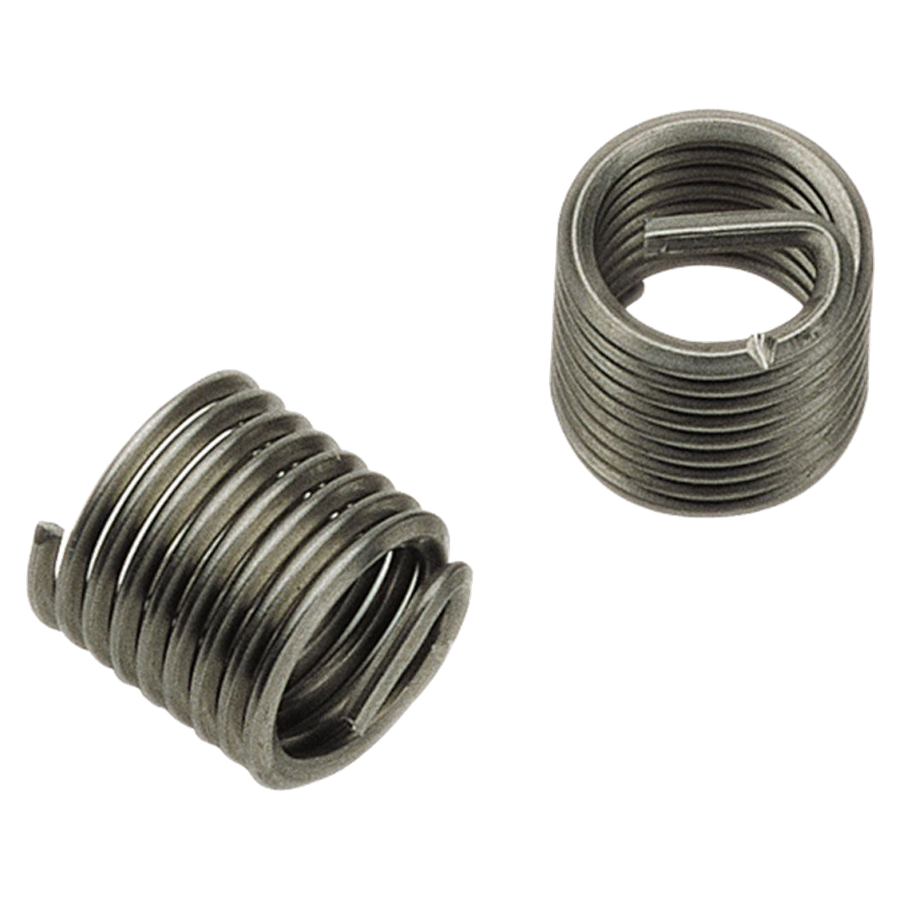
The wire threaded insert is a precision coil of diamond-profile stainless wire that creates a strong, wear-resistant internal thread in soft or critical parent materials. Wound into an STI-tapped hole, it spreads the bolt load over a larger area and protects the parent metal from wear and galling. Also known as a helical thread insert or screw thread insert, it is used both in new production and to repair stripped threads back to their original size. This is the tanged, free-running type, supplied in SS 304 and Nitronic 60 for aerospace, defence and OEM production.
STI taps, installation & tang break-off tools on request
Lead Time & Certificates
On enquiry · Test certificate on request
Available In
SS 304
General OEM use
Nitronic 60
Anti-galling, high temp
Other materials on request
Available Thread Systems
Every insert is wound to give a standard internal thread of the original size, so your existing bolts and drawings stay unchanged. Tell us the thread and length you need and we will confirm availability.
Metric
Coarse & fine pitch · DIN 8140
The most widely used range for Indian, European and Asian OEM equipment, including fine pitch threads common in automotive and aerospace parts.
UNC
Unified coarse · ASME B18.29.1
For American-standard equipment, imported machinery and inch-series assemblies built to US drawings.
UNF
Unified fine · ASME B18.29.1
The fine-pitch inch thread most used in aircraft structures, engines and defence equipment where vibration resistance matters.
BSP
British pipe (G) · ISO 228-1 form
For hydraulic, pneumatic and fluid ports in valve bodies, manifolds and pump housings made from aluminium or cast metal.
BSW
British Whitworth · BS 84 form
For maintaining and repairing older British-built machinery, railway and defence equipment still running on Whitworth threads.
BSF
British Standard Fine · BS 84 form
The fine-pitch British thread found on legacy engines, vehicles and aircraft parts that still need genuine thread repair.
Insert Lengths
Length is stated as a multiple of the nominal thread diameter (D). A longer insert engages more parent material and carries more load, which matters most in soft alloys.
1D
1.5D
2D
2.5D
3D
Example: a 1.5D insert for an 8 mm thread is 12 mm long.
How It Is Installed
Four steps, done with simple hand tools or a powered installation tool on the production line.
1
Drill
Drill the hole to the size specified for the STI tap. For a repair, the old damaged thread is drilled out completely.
2
Tap with an STI Tap
Cut the thread with an STI (screw thread insert) tap. It is oversize, so the coil can sit around the bolt thread.
3
Wind In the Insert
The installation tool grips the tang (orange) and winds the coil in until it sits just below the surface.
4
Break Off the Tang
Snap the tang off at its notch with a break-off tool and remove it. The hole now takes the original bolt size.
Why OEMs Use Wire Threaded Inserts
Stronger threads in soft metals
The larger STI hole spreads the bolt load over more aluminium, magnesium or cast material, so the thread resists stripping.
Thread that does not wear out
The hard, smooth stainless wire takes the wear of repeated assembly, so service and maintenance points stay reliable.
No galling or seizing
Steel and stainless bolts run against stainless wire instead of soft parent metal, which prevents thread pick-up and seizure.
Corrosion protection
A stainless thread surface resists corrosion and avoids bolts seizing in aluminium housings exposed to moisture or heat.
Repair to original size
Stripped or worn threads are restored to the same bolt size, saving expensive castings and machined parts from scrap.
Compact and light
A wire coil needs far less wall thickness than a solid insert, so bosses stay small and part weight stays low.
Where Is It Used?
Click your industry to see how wire threaded inserts are used.
SS 304 or Nitronic 60 — Which to Choose?
SS 304
Standard choice · Most applications
✓The standard material for wire threaded inserts worldwide
✓Good corrosion resistance in general and outdoor use
✓Suits aluminium, magnesium, cast iron and plastic parent materials
✓Cost-effective for high-volume OEM production
Nitronic 60
High-performance · Aerospace & defence
✓Excellent resistance to galling, even with stainless or titanium bolts
✓High wear resistance for joints assembled and removed many times
✓Keeps its properties at elevated temperature, near engines and exhausts
✓Preferred for aerospace, defence and other critical assemblies
Need a different material? Other materials are available on request. Share your requirement and we will confirm.
Quick Reference
6
Thread Systems
1D–3D
Insert Lengths
SS 304
& Nitronic 60
DIN 8140
Metric Standard
Installation Tips
▸ Always use an STI tap. A standard tap of the same size gives a hole that is too small for the insert.
▸ Clean all chips and cutting fluid out of the tapped hole before installing, especially in blind holes.
▸ Wind the insert in until the top coil sits about a quarter to half a turn below the surface, so it is fully supported by the parent material.
▸ Break the tang off with a proper tang break-off tool, then remove and count every tang on aerospace and electronics assemblies.
▸ Do not reuse an insert after extraction. Fit a new one in the existing STI thread.
Frequently Asked Questions
What is a wire threaded insert and how does it work?
A wire threaded insert, also called a helical thread insert or screw thread insert (STI), is a precision coil of diamond-profile stainless steel wire. The hole is drilled and tapped with a special STI tap, and the coil is wound into that thread. Once fitted, its inner face forms a standard internal thread of the original size, so the normal bolt or screw is used. Because the coil is slightly larger than the tapped hole before fitting, it presses outwards against the parent material and stays in place without adhesive, staking or locking.
What does free-running mean on a wire threaded insert?
Free-running means every coil of the insert is a smooth, round thread, so the bolt turns in and out freely with no added friction. It behaves like a normal well-made internal thread. This is different from a screw-locking insert, which has a deformed coil that grips the bolt to resist loosening under vibration. Free-running is the standard choice for most OEM assemblies where the joint is held by correct tightening torque, a locking washer or a thread-locking compound.
What is the tang on a wire threaded insert, and does it have to be removed?
The tang is a short length of wire bent across the bottom of the coil. The installation tool engages it to wind the insert into the tapped hole. After the insert is fitted, the tang is normally broken off at its notch with a tang break-off tool so the bolt can pass through the full length of the insert. In a through hole the tang drops out of the far side. In a blind hole it falls to the bottom and should be removed with a magnet or pliers so it does not stop the bolt from seating. Always count removed tangs on critical assemblies such as aerospace and electronics so no loose tang is left inside the part.
Is a wire threaded insert stronger than a normal tapped thread?
In soft parent materials such as aluminium, magnesium and cast alloys, a wire threaded insert usually gives a stronger and longer-lasting thread than tapping the material directly. The STI tapped hole is larger than a standard tapped hole, so the load is spread over a bigger shear area in the parent material. The hard stainless wire also takes the wear of repeated assembly instead of the soft parent metal, and it does not gall against steel bolts. The exact strength depends on the parent material, insert length and bolt grade, so the insert length should be chosen from your joint design.
Which tap and drill do I need to install a wire threaded insert?
You need an STI (screw thread insert) tap made for the thread size of the insert. A standard tap of the same size will not work, because the hole has to be tapped oversize so the coil fits around the bolt thread. The drill size is set by the STI tap and is given in the tap and insert installation data. You also need an installation tool for tanged inserts and a tang break-off tool. Excel Trading Corporation supplies STI taps, installation tools, tang break-off tools and extraction tools on request alongside the inserts.
What insert length should I choose: 1D, 1.5D, 2D, 2.5D or 3D?
The length is given as a multiple of the nominal thread diameter, so a 1.5D insert is one and a half times the thread diameter long. A longer insert spreads the bolt load over more parent material. As a general guide, harder parent materials such as steel and cast iron can use shorter inserts, while softer materials such as aluminium and magnesium alloys typically use 1.5D to 2D or longer. 1.5D and 2D are the most widely used lengths. For critical joints, the length should come from your design calculation so that the bolt, not the parent thread, is the weakest part of the joint.
Should I choose SS 304 or Nitronic 60 wire threaded inserts?
SS 304 is the standard material for wire threaded inserts and suits most applications in aluminium, magnesium, cast iron and plastics, with good corrosion resistance and strength. Nitronic 60 is a high-performance austenitic stainless steel chosen mainly for its excellent resistance to galling and wear, and for good performance at elevated temperature. It is preferred where bolts are assembled and removed many times, where stainless or titanium bolts are used, and in aerospace and defence equipment. Other materials can be supplied on request.
Can a wire threaded insert repair a stripped thread?
Yes. Thread repair is one of the most common uses. The damaged thread is drilled out to the specified drill size, re-tapped with an STI tap and a new insert is fitted. The repaired hole takes the same bolt size as the original, so no drawing change or oversize bolt is needed. This makes wire threaded inserts a common way to save costly castings, engine blocks, housings and machined parts that would otherwise be scrapped.
Can a wire threaded insert be removed or reused?
An installed insert can be removed with an extraction tool, which grips the coil and winds it out of the hole without damaging the STI tapped thread. A removed insert is distorted and should not be reused. A new insert of the same size is simply fitted into the existing tapped hole, so the part can be repaired again in the future.
Which standards do your wire threaded inserts follow?
Metric wire threaded inserts are supplied to DIN 8140. UNC and UNF inserts follow ASME B18.29.1, the standard for inch-series helical coil screw thread inserts. BSW and BSF inserts are made for the BS 84 thread form, and BSP inserts for the BSP parallel pipe thread form of ISO 228-1. Test certificates can be provided on request with your order.
Where can I buy wire threaded inserts in Bangalore or India?
Excel Trading Corporation supplies tanged free-running wire threaded inserts in SS 304 and Nitronic 60 from Bengaluru to OEMs across India. Metric, UNC, UNF, BSP, BSW and BSF threads are available in 1D to 3D lengths, with STI taps and installation tools on request. Lead time is confirmed on enquiry. Call +91 7204435253 or email info@exceltrading.in with the thread size, length, material and quantity you need.