What is a Round Body Rivet Nut?
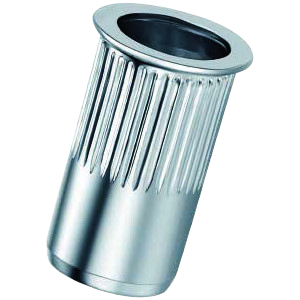
The Round Body Rivet Nut is the most widely used threaded insert in the world — and for good reason. It installs from one side only into a standard round drilled hole, making it ideal for tubes, panels, enclosures, and any application where you cannot access the back of the material. The knurled (textured) surface on the body bites into the parent material as the rivet nut is set, dramatically increasing grip and resistance to spinning under torque or vibration — a critical requirement in automotive, HVAC, and industrial assembly.
Why the Knurls Matter
A plain round body rivet nut relies purely on friction from the collapsed bulge to stay in place. A knurled body goes further — the raised diamond or cross-hatch pattern on the exterior physically embeds into the hole wall as the fastener is set. This gives you significantly better anti-rotation performance without needing a hex-shaped hole. It makes the round body knurled rivet nut the best choice when you're working with softer materials like aluminium sheet, thin steel, plastic panels, or composite materials where a plain body would spin under load.
Key Advantages
-
 One-Sided Installation — no access to the back of the panel needed. Drill a standard round hole, insert, and set with a rivet nut tool. Done.
-
Knurled Body for Spin-Out Resistance — the textured surface bites into the parent material under setting load, locking the nut in place against turning forces
-
Standard Round Hole — no special hex punching or laser cutting required, just a regular drilled hole. Lowest tooling cost of any rivet nut type
-
Works on Material as Thin as 0.5mm — suitable for thin sheet metal, aluminium, plastic, fibreglass, and carbon composite panels
-
Variable Screw Length (Open End) — the open end style allows the bolt to pass fully through so screw length can be adjusted freely
-
Reusable Permanent Thread — once set, it provides a clean internal metric thread that can be assembled and disassembled repeatedly without degrading
-
Replaces Weld Nuts — no heat, no welding equipment, no distortion of the base material. Faster and cleaner than traditional weld nut assembly
Style
-
Open End — bolt passes fully through. Best when screw length needs to vary or when using longer bolts in through-applications
-
Closed End — sealed bottom prevents ingress of water, dust, gas, and chemicals. Essential for outdoor, marine, or pressure-sensitive joints
Flange Options
-
Large Flange — maximum load distribution over the panel face. Best for thin or soft materials where pull-through is a risk
-
Reduced Flange — smaller head for tight spaces, recessed areas, or where a lower profile is needed without going fully flush
-
Countersunk — the flange sits flush with the panel surface for a clean, flat finish. Used in visible or aerodynamic surfaces
Industries & Applications
- Automotive body panels, doors, brackets & enclosures
- HVAC ducting, air handling units & sheet metal fabrication
- Electronics cabinets, switchgear & electrical enclosures
- Heavy trucks, trailers & agriculture machinery
- Construction equipment & industrial frames
- Bicycles, fitness equipment & recreational products
- Plastic, fibreglass & composite panel assemblies
Installation Note: Round body knurled rivet nuts install into a standard round drilled hole — no special punching required. Use a manual hand tool for low-volume work or a pneumatic/battery-powered rivet nut tool for high-volume production. Always match the mandrel size to the thread size of the rivet nut for a clean, reliable set.
Available In

Steel

Stainless Steel