Back to Nuts

Hex Flange Nut with Serration

DIN 6923  ·  Steel Zn/Blue Plated  ·  A2 & A4 Stainless  ·  M5 to M20

The hex flange nut with serrationDIN 6923 — combines a hexagon nut with a wide integrated flange in place of a loose washer, plus fine serrations under the flange that bite into the clamped surface on tightening. The result is a one-piece fastener with a built-in mechanical lock against vibration and shock loosening — no nylon insert, spring washer or thread-locking compound required. Excel Trading Corporation stocks steel with zinc/blue plating, A2 & A4 stainless steel, and Grade 10.9 on order, M5 to M20.

Specifications

Standard

DIN 6923

Also Known As

Serrated Flange Nut · Whiz Lock Nut

Thread Sizes

M5 · M6 · M8 · M10 · M12 · M16 · M20

Materials

Steel — Zn/Blue Plated · A2 & A4 Stainless Steel

High Tensile Option

Grade 10.9 — available on order

Locking Mechanism

Under-flange serration — all-metal, no nylon insert
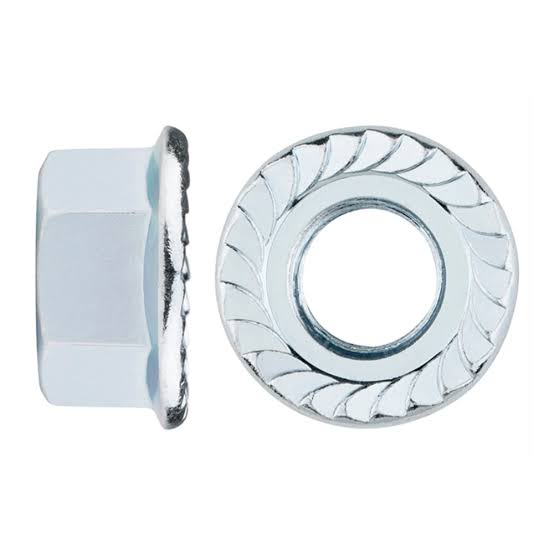
Hex Flange Nut with Serration DIN 6923 M5 M6 M8 M10 M12 M16 M20 India

Available In

Steel Zn/Blue

Standard stock

A2 / A4 Stainless

Corrosive environments

Grade 10.9

High-tensile steel — on order only

DIN 6923 Size & Tolerance Chart

Dimensions below are per DIN 6923. Pitch (P) is the thread pitch, across flat (s) is the wrench/spanner size (max = nominal, min = tolerance floor), across corner (e min) is the minimum diameter across the hex corners, and thickness (m) is the nut height from flange to top face.

M14 is included below for full standard reference. Excel Trading Corporation stocks M5, M6, M8, M10, M12, M16 and M20 as standard — M14 is available on request.

Thread Pitch — P (mm) Across Flat max — s (mm) Across Flat min — s (mm) Across Corner min — e (mm) Thickness max — m (mm) Thickness min — m (mm)
M5 0.80 8.00 7.78 8.79 5.00 4.70
M6 1.00 10.00 9.78 11.05 6.00 5.70
M8 1.25 13.00 12.73 14.38 8.00 7.60
M10 1.50 15.00 14.73 16.64 10.00 9.60
M12 1.75 18.00 17.73 20.03 12.00 11.60
M14 (on request) 2.00 21.00 20.67 23.36 14.00 13.30
M16 2.00 24.00 23.67 26.75 16.00 15.30
M20 2.50 30.00 29.67 32.95 20.00 18.90

How the Serration Lock Works

1

Flange Spreads the Load

The wide integrated flange acts as a built-in washer, distributing clamp load over a larger bearing area than a standard hex nut — no separate washer to fit or lose.

2

Serrations Bite In

As the nut is torqued down, the hardened radial serrations under the flange dig into the clamped surface, creating a mechanical interlock rather than relying on friction alone.

3

Locked Against Vibration

The interlock resists the joint working loose under vibration or shock — a fully mechanical, all-metal lock that does not rely on a nylon insert or thread adhesive.

Where Is It Used?

Click your industry to see how serrated flange nuts are used.

Serrated Flange Nut vs Plain Hex Nut + Flat Washer

Hex Flange Nut with Serration

One piece · Integrated flange · Mechanical lock

  • One part to pick, stock and assemble — no washer to fit separately or drop on the line
  • Serrations give a genuine mechanical anti-vibration lock, not friction alone
  • Flange bearing area is guaranteed and concentric every time — cannot be misaligned
  • All-metal — unaffected by heat, oil or solvent exposure
  • Serrations mark the clamped surface finish — avoid on visible cosmetic faces

Plain Hex Nut + Flat Washer

Two piece · Loose washer · Friction only

  • Leaves the clamped surface unmarked — better for visible or coated cosmetic faces
  • Washer size and thickness can be varied independently of the nut
  • Two loose parts per joint — an extra line item to stock and a part that can be missed on assembly
  • No inherent vibration lock — needs a spring washer or thread adhesive added separately
  • Washer can shift off-centre or be installed the wrong way round

Quick Reference

M5–M20

Thread Range

DIN 6923

Standard

Steel + A2/A4

Materials

10.9

High-Tensile Grade — On Order

Installation Tips

  • Torque to the joint's specification — under-tightening prevents the serrations from biting in fully, defeating the anti-vibration lock.
  • Avoid using serrated flange nuts on painted, plated or cosmetic surfaces where the serration marking would be visible or would compromise a coating's corrosion protection.
  • A serrated flange nut is designed for one-time torque-to-spec installation — repeated removal and reinstallation on the same joint gradually reduces the serration's grip.
  • Confirm your required grade before ordering — Grade 10.9 is stocked on order only and carries a longer lead time than standard steel or stainless.

Related Products

Frequently Asked Questions

What is a hex flange nut with serration — and what does DIN 6923 cover?

A hex flange nut with serration is a hexagon nut with a wide integrated flange in place of a separate flat washer, and fine radial serrations machined into the underside of the flange. DIN 6923 is the German standard that defines its dimensions — thread pitch, width across flats, width across corners and nut thickness — for sizes from M5 up to M39. Excel Trading Corporation stocks M5, M6, M8, M10, M12, M16 and M20.

What do the serrations under the flange actually do?

As the nut is tightened, the hardened serrated ridges under the flange bite into the mating surface while the flange face itself stays clamped. This creates a mechanical interlock that resists back-off from vibration and shock loading — without a nylon insert, spring washer or thread-locking adhesive. The lock is entirely mechanical, so it does not degrade with heat, oil or chemical exposure the way a nylon insert lock nut can.

Is a serrated flange nut a substitute for a nylon insert (nyloc) lock nut?

In vibration-resistance terms, yes — both are designed to prevent loosening. The serrated flange nut is the better choice above roughly 120°C or wherever oil, coolant or solvent exposure would degrade a nylon insert, since it is all-metal. A nyloc nut gives a more consistent prevailing torque and is reusable more times without losing its lock. For EV battery packs, engine bays and other heat-exposed joints, the serrated flange nut is generally preferred.

What is the difference between this and a plain hex nut with a separate flat washer?

A plain hex nut plus a loose flat washer is a two-piece assembly — the washer can be omitted, installed the wrong way round, or fall out during handling on an automated line. The hex flange nut with serration is one piece: the flange is forged integrally with the nut body, so bearing area and serration engagement are guaranteed every time, assembly is faster, and there is one less loose part to manage in a bill of materials.

What materials and grades are available, and when do I need Grade 10.9?

Standard stock is steel with zinc/blue plating for general indoor and mild outdoor use. A2 and A4 stainless steel are stocked for corrosion resistance — A4 for coastal, washdown or chemical exposure. Grade 10.9 high-tensile steel is available on order for high-preload structural and automotive joints where a standard property class 8 nut does not meet the required clamp load — confirm your joint's torque specification with us before ordering.

Where can I buy DIN 6923 serrated flange nuts in Bangalore?

Excel Trading Corporation stocks DIN 6923 hex flange nuts with serration in steel (zinc/blue plated), A2 and A4 stainless steel at our Kumbarpet store in Bengaluru, M5 to M20. Grade 10.9 is available on order. We supply automotive assemblers, EV and lithium battery pack manufacturers, solar EPC contractors and general industry across Karnataka and India-wide. Call +91-9448239476 or email info@exceltrading.in for pricing and bulk availability.