Insert Press Nut

Kalei Nut  ·  hex Press Nut  ·  Set Nut  ·  M3 to M20 & Stainless Steel

The insert press nut — widely known as a kalei nut or set nut — is a hexagonal press-fit threaded insert for thin sheet metal. The knurled body is pressed into a pre-punched hole using a standard pneumatic or hydraulic press. As it seats, the knurling bites into the surrounding metal, creating a permanent, flush, reusable thread with no welding, heat or special tooling. One-side access only. Excel Trading Corporation stocks in stainless steel SS304, M3 to M20.

Specifications

Also Known As

Kalei Nut · Set Nut · Press Fit Nut · Press-In Nut

Thread Sizes

M3 · M4 · M5 · M6 · M8 · M10 · M12 · M16 · M20

Materials

Stainless Steel A2 (SS304)

Body Shape

Hexagonal with knurled outer body

Min Sheet Thickness

1.0 mm

Installation

Pneumatic / hydraulic press — no special tools
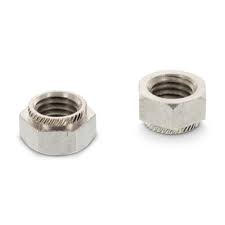
Insert Press Nut Kalei Nut Set Nut M2 M2.5 M3 M4 M5 M6 M8 M10 M12 M16 20 India

Available In

Stainless A2 SS304

Outdoor & corrosive

Size Reference Table

The hole diameter in your sheet must be slightly smaller than the knurled body so the nut bites into the material on pressing. The table below gives typical hole sizes — always confirm with the specific product datasheet for your sheet thickness.

Thread Body Width A/F (mm) Thickness (mm) Outer Dia
M3 5.5 3.00 4.70
M4 7.00 3.20 5.7
M5 8.0 4.00 6.75
M6 10.00 5.00 8.30
M8 13.00 6.50 10.30
M10 15.00 8.00 12.85
M12 17.00 10.00 14.85
M16 22.00 13.00 18.85
M20 27.00 16.00 23.40

How It Works

1

Punch the Hole

Punch or drill a clean hole in the sheet metal to the specified diameter — slightly smaller than the nut's knurled body width.

2

Press In

Position the nut in the hole and press using a standard pneumatic or hydraulic press. The knurled hexagonal body squeezes into the metal — no special tools required.

3

Permanent Flush Thread

The nut sits flush with the sheet surface. The deformed metal locks it permanently — a strong, reusable thread ready for bolt assembly from the other side.

Where Is It Used?

Click your industry to see how insert press nuts are used.

Insert Press Nut vs Rivet Nut — Which to Choose?

Insert Press Nut (Kalei Nut)

Press installation · Hexagonal body · Flush finish

  • Installed with standard pneumatic or hydraulic press — no special tools
  • Hexagonal body provides excellent anti-rotation under bolt torque
  • Sits completely flush — no protrusion on either face of the sheet
  • Faster installation cycle on production press tools
  • Requires press access — not suitable for field installation
  • Minimum 1.0mm sheet thickness required

Rivet Nut (Blind Rivet Nut)

Tool installation · Collapse body · Blind side grip

  • Installed with a hand rivet nut tool — no press needed
  • Suitable for field installation and rework after assembly
  • Works on very thin sheet from 0.5mm and thicker
  • Round body can rotate under high torque — use hexagonal body rivet nut for anti-rotation
  • Slightly slower installation per piece vs press nut on a production line

Quick Reference

M3–M10

Thread Range

1.0mm+

Min Sheet Thickness

Steel + SS

Materials

1-Side

Access Required

Installation Tips

  • The hole must be punched clean with no burrs — a burr around the hole edge prevents the nut from seating flush and reduces pull-out strength.
  • Press squarely — if the nut tilts during pressing, the thread will not be perpendicular to the sheet surface and will cause bolt cross-threading on assembly.
  • Use the correct hole size from the table above — too large a hole reduces knurling engagement and pull-out strength significantly.
  • No special tooling required beyond a flat-faced press platen. Existing pneumatic presses in sheet metal shops install these without modification.

Frequently Asked Questions

What is an insert press nut — and why is it also called a kalei nut or set nut?

An insert press nut is a hexagonal threaded insert pressed permanently into thin sheet metal — creating a reusable threaded connection with no welding or heat. The name "kalei nut" comes from a specific product series name that became widely used as a generic term in the Indian and Asian fastener market, similar to how "pem nut" is used in western markets. "Set nut" is another common trade name for the same product. All three names — insert press nut, kalei nut and set nut — refer to the same hexagonal press-fit sheet metal insert.

What is the correct hole size for my insert press nut?

Refer to the size table above for standard hole diameters. As a general rule, the hole must be slightly smaller than the knurled body to ensure the knurling bites into the sheet on pressing. Using a hole that is too large is the most common installation error — the nut may seat but will have very low pull-out strength and may spin under bolt torque. Always punch to the dimension listed, not drill, as punching gives a cleaner hole edge.

When should I use a press nut instead of a rivet nut?

Use a press nut (kalei nut) when you have press access during manufacturing and want the fastest possible installation cycle on a production line — press nuts install in a single press stroke with no manual tooling. Use a rivet nut when you need field installation without a press, when sheet thickness is below 1.0mm, or when the part is already assembled and you cannot access a press. For sheet metal enclosure and switchboard manufacturing with a punch press already in use, press nuts are almost always the faster and lower-cost solution.

Where can I buy kalei Nuts in Bangalore?

Excel Trading Corporation stocks insert press nuts — kalei nuts and set nuts — in stainless steel at our store in Bengaluru, available M2 to M20. We supply to switchboard manufacturers, electronics enclosure fabricators, sheet metal shops and general industry across Karnataka and India-wide. Call +91-9448239476 or email info@exceltrading.in for pricing and bulk availability.