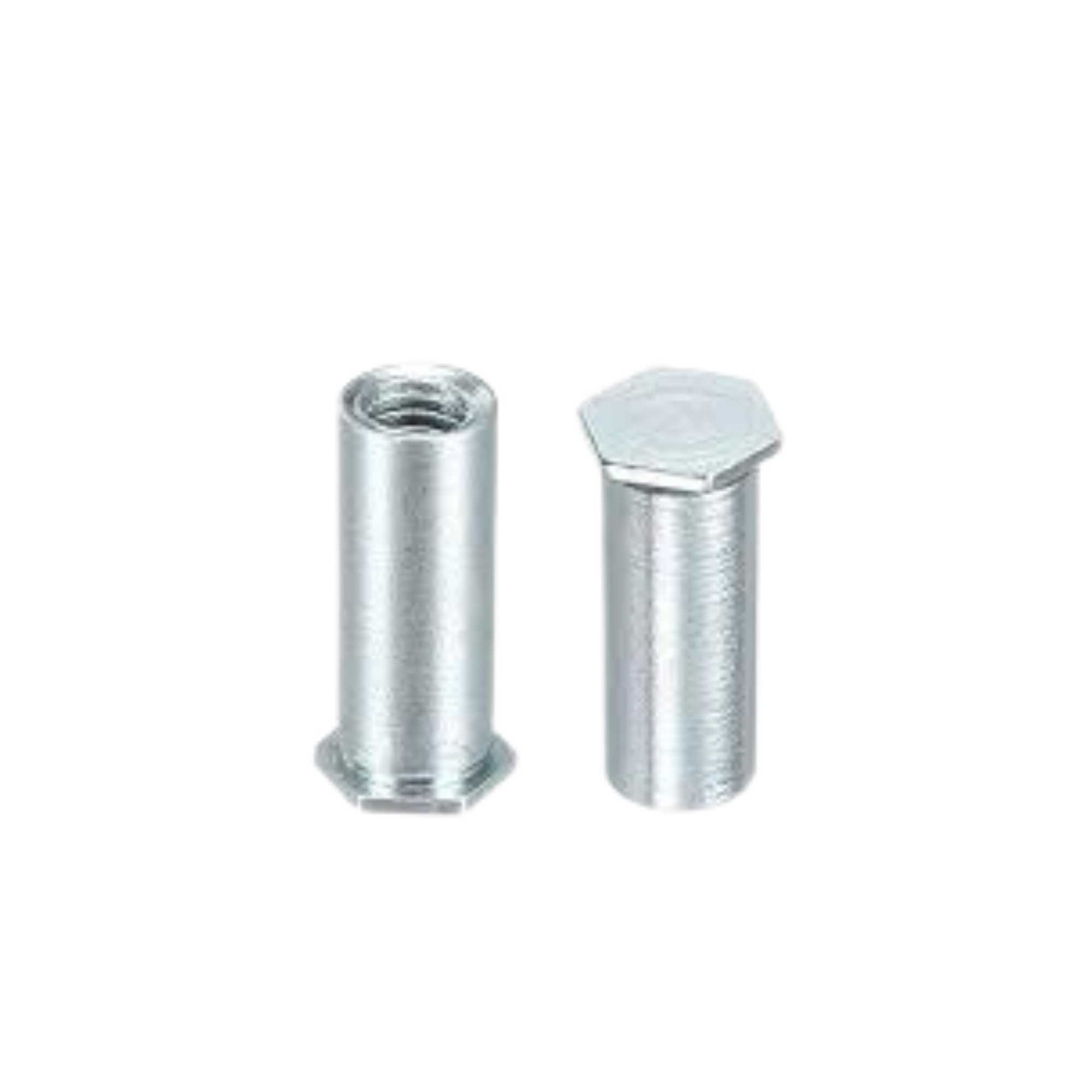
How the Self Clinching Standoff Works
The self clinching standoff uses the same cold-forming principle as the self clinching nut but in reverse geometry. Instead of creating a female thread inside the sheet, it creates a male spacing barrel that protrudes from the sheet. The hexagonal head is driven flush into the installation-side surface under squeezing force. The sheet metal surrounding the mounting hole is displaced into the undercut groove below the hex head, locking the standoff permanently against axial pull-out. The hex profile prevents any rotation under torque when the mating fastener is assembled.
The result is a rigid standoff that is integral to the panel — not a loose spacer that can fall out during assembly. The flush head side presents a completely smooth surface with no protrusion, which is critical for chassis assemblies where adjacent panels, PCBs or covers must sit flat against the sheet.
The critical differential hardness rule
The standoff must always be harder than the host sheet. SO and BSO-type carbon steel standoffs work in steel and aluminium sheets up to HRB 80. SOS and BSOS stainless steel standoffs work in sheets up to HRB 70. Standard cold-rolled steel (CRS) sheet is typically HRB 60–75, well within both limits. Never attempt to install carbon steel SO/BSO into stainless steel panels — the sheet is harder than the fastener and clinching will fail.
Why Use a Clinch Standoff Instead of a Screwed Spacer?
Brass hex spacers with threaded ends are common in India and appear cheaper at first glance. However, they require three hardware components per mounting point — the spacer itself, a screw from below and a screw from above — and they remain loose hardware until assembled. On a production line, loose spacers drop, fall out of alignment, and require two-handed assembly. Yield loss from misaligned or dropped spacers in high-volume EMS production in India is a well-documented cost.
The self clinching standoff eliminates all of this. It is pressed into the chassis panel before the assembly line — when the PCB arrives at the assembly station, the standoffs are already in place, fixed in the correct position, at the exact height. The PCB drops onto the standoff barrels and is secured with a single screw from above. One fastener, one operation, zero loose hardware.
EMS and electronics manufacturing in India
India's electronics manufacturing sector — server chassis, networking hardware, power electronics, telecom equipment and EV battery management systems — increasingly specifies self clinching standoffs as the chassis fastener of choice, replacing brass spacers. Excel Trading Corporation stocks M3, M4, M5 and M6 in all four types from our Bengaluru warehouse for rapid replenishment to EMS operations across Karnataka, Tamil Nadu and Andhra Pradesh.
Installation — Critical Rules
Self clinching standoffs must be installed using a squeezing press — bench press, C-frame, hydraulic or pneumatic — with a flat punch on the head side and a flat, non-chamfered anvil supporting the panel from below. The punch and anvil must be parallel. The panel must rest flat on the anvil; never leave a gap between the panel and the support surface or the standoff barrel may fracture under the installation force.
Installation Checklist
-
▸
Punch the mounting hole to the correct size — hold the hole diameter to +0.05mm / -0.00mm tolerance. Too large a hole reduces push-out resistance; too small prevents the standoff from seating.
-
▸
Do NOT deburr or chamfer the hole. The punched edge material must remain intact — it flows into the undercut during installation. Deburring removes exactly the material you need.
-
▸
Install into bare, uncoated sheet metal. Paint or powder coating fills the undercut space and prevents proper metal flow — push-out resistance will be near zero in a coated hole.
-
▸
Support the panel fully on the anvil. The panel must rest on the standoff barrel end — if there is a gap between the barrel tip and the anvil, the barrel may crack under press force.
-
▸
Apply only enough force to embed the head flush. Over-pressing dents the panel surface and can distort the sheet around the standoff, reducing planarity of the assembled PCB.
What is a self clinching standoff and how does it work?
A self clinching standoff provides a permanent, flush-mounted threaded barrel in thin sheet metal. Pressed into a punched hole, the hexagonal head embeds flush while the surrounding metal cold-flows into the undercut groove, locking the standoff permanently. The protruding barrel creates a rigid spacing or PCB mounting post with high torque-out and pull-out resistance. No welding, heat or adhesive required. The thread is fully reusable — the standoff stays fixed in the panel while the mating bolt is assembled and disassembled repeatedly.
What is the difference between SO-type and BSO-type self clinching standoffs?
SO-type (thru-hole) standoffs have threads running the full length of the barrel — a bolt can pass completely through. Used for panel stacking and PCB mounting with through-bolt access. BSO-type (blind) standoffs are threaded only at the open end — the base is closed. Used where the reverse side must remain sealed, such as in IP-rated outdoor enclosures, sealed cabinets and coastal telecom installations. Both types are available in carbon steel (zinc plated) and stainless steel.
Can self clinching standoffs be used for PCB mounting?
Yes — they are the industry standard for PCB mounting in electronics enclosures worldwide. The standoff is pressed into the chassis sheet before the assembly line. On the assembly station the PCB drops over the standoff barrels, and a single screw from above clamps the PCB at the correct height above the chassis. This eliminates loose brass spacers, reduces hardware count and dramatically speeds up PCB mounting in EMS production.
What is the minimum sheet thickness for a self clinching standoff?
For SO and BSO-type (carbon steel) in M3 to M5, the minimum sheet thickness is 0.63mm. For M6, the minimum is 1.02mm. The sheet must be within the hardness limit — HRB 80 for carbon steel SO/BSO and HRB 70 for stainless SOS/BSOS types. Standard cold-rolled steel sheet is typically HRB 60–75, well within both limits.
Can self clinching standoffs be installed into stainless steel panels?
Not with SO, BSO, SOS or BSOS types. Stainless steel panels are typically HRB 90 or harder — exceeding the limit for all standard types. For stainless steel panels, a 400-series hardened stainless steel SO4 or BSO4-type is required. Contact us on +91 7204435253 to discuss standoffs for stainless sheet applications.
Where can I buy self clinching standoffs in Bangalore?
Excel Trading Corporation stocks PEM SO-type and BSO-type equivalent self clinching standoffs in M3, M4, M5 and M6 — carbon steel zinc plated and 300-series stainless steel — at our Kumbarpet store in Bengaluru. We supply across Karnataka, Tamil Nadu, Andhra Pradesh, Telangana, Kerala and India-wide. Call +91 7204435253 or email info@exceltrading.in for pricing and availability.
 PCB mounting in electronics enclosures — server chassis, desktop PC cases, networking hardware