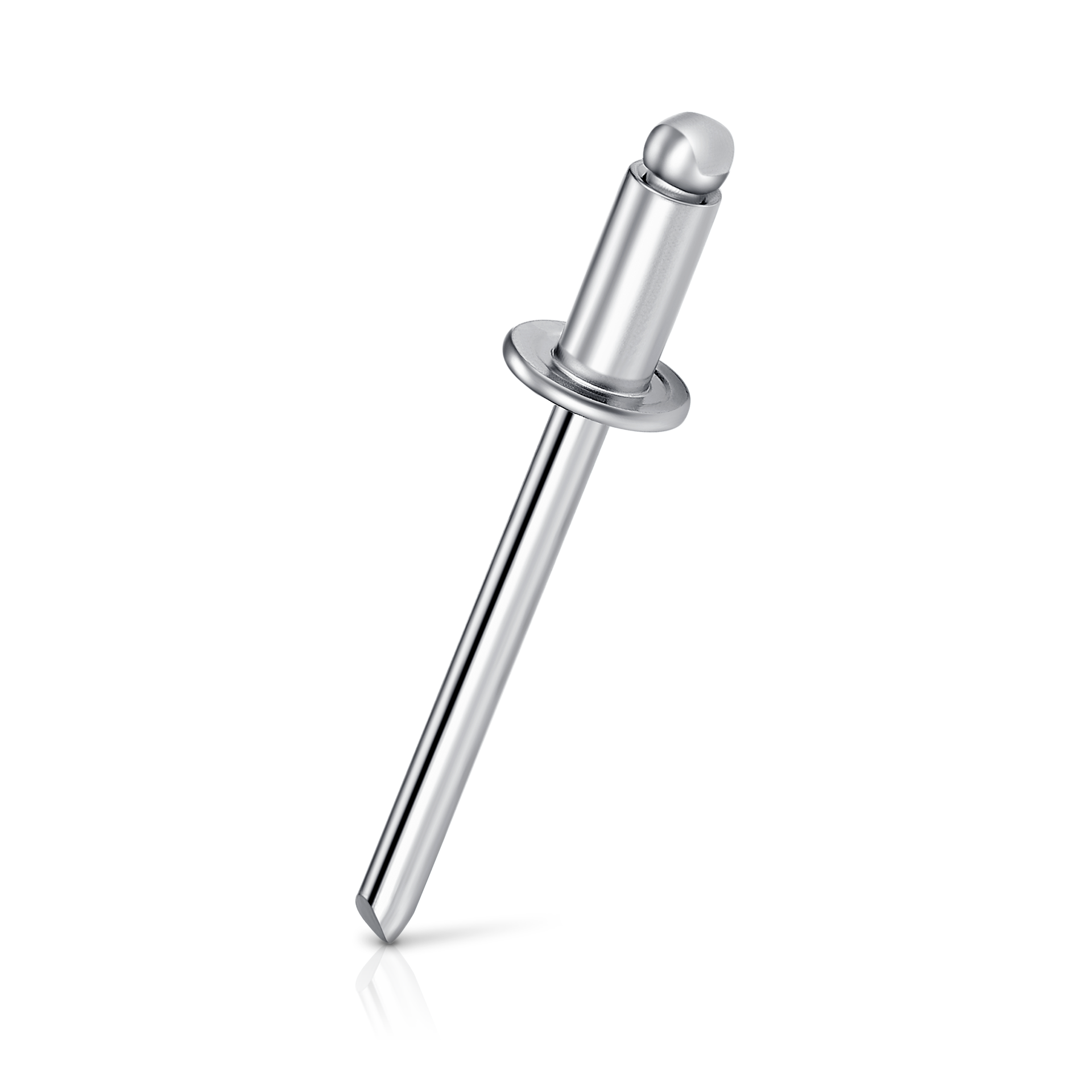
Standard Industrial Pop Rivet · Steel, Stainless Steel & Aluminium · 2.4 mm to 6.4 mm
Open end blind rivets are stocked across four material combinations at our Bengaluru store. Grip range is the total combined sheet thickness the rivet will correctly clamp. Always drill the hole to the exact diameter shown — an oversized hole reduces clamping force.
An open end blind rivet — also called a standard pop rivet or break-stem rivet — is the most widely used blind fastener in industry. It is installed from one side only: the rivet body is inserted through a pre-drilled hole, the mandrel stem is pulled by a rivet gun, the blind end expands into a wide bearing flange, and the mandrel breaks flush. The open end design means the mandrel hole remains visible after setting — this is the defining characteristic and the trade-off for its very low cost and universal availability. It is the right choice for the vast majority of general fastening tasks where the joint is not exposed to continuous liquid immersion or extreme vibration.
Standard Grade · Most Economical
The highest shear and tensile strength of all three options. Zinc plating gives adequate corrosion protection for indoor and dry environments. The go-to choice for general fabrication, construction framing, automotive bodywork and any application where cost matters and the joint will not be exposed to moisture long-term.
Best for: Construction · General fabrication · Automotive · Furniture
300-Series · Corrosion Resistant
Full corrosion resistance for outdoor, coastal and humid environments. Slightly lower shear strength than steel but far superior durability where moisture, salt air or chemical exposure is a factor. The correct choice for roofing, cladding, signage, food-processing equipment and any joint that will be permanently exposed to the elements.
Best for: Roofing · Signage · Food equipment · Coastal cladding
Lightweight · Non-Magnetic
Significantly lighter than steel — the preferred option wherever weight is a design consideration. Non-magnetic and galvanically compatible with aluminium host panels, preventing bimetallic corrosion. Widely used in vehicle bodywork, lightweight frames, plastics, leather goods and office furniture where a clean finish matters.
Best for: Aluminium panels · Plastics · Leather goods · Lightweight frames
Drill a clean hole to the exact diameter specified for the rivet — typically 0.1 to 0.2 mm larger than the rivet body. A hole that is too large will result in a loose, under-clamped joint. Deburr both faces of the hole before inserting the rivet.
Insert the rivet body fully through the hole from the accessible side. The flange head should sit flat against the material surface with no gap. Place the rivet gun nosepiece over the mandrel stem firmly before squeezing.
Squeezing the rivet gun pulls the mandrel stem through the rivet body. This draws the blind end of the rivet toward the material, expanding it into a wide bearing flange that clamps the sheets together from behind — no access to the blind side is needed.
Once the clamp load reaches the set point, the mandrel breaks at the pre-cut break point. The stem is ejected and the rivet body remains permanently installed. The open hole left by the mandrel is the defining characteristic of this rivet type.
2.4–6.4
Diameters (mm)
3
Materials Available
24 mm
Max Grip Range
Open
End Type
An open end rivet leaves the mandrel hole exposed after setting, which means moisture can potentially enter the joint from the blind side. A sealed blind rivet has a cap that closes this hole after the mandrel breaks. For outdoor, wet or corrosive environments, a sealed rivet is the better choice. For dry or indoor applications, the open end rivet is more economical and performs equally well.
Choose steel for maximum strength at lowest cost in indoor applications. Choose stainless steel for outdoor, coastal or humid environments where corrosion resistance is essential. Choose aluminium when joining aluminium panels (to avoid bimetallic corrosion), when weight reduction matters, or when riveting plastics and leather where a lighter, softer rivet causes less material distortion.
Measure the total combined thickness of all the materials you are joining — this is your grip. Select a rivet length whose stated grip range includes your measured stack thickness. If your stack is 5 mm, for example, you need a rivet where the grip range covers 5 mm. Installing a rivet outside its grip range will result in either under-expansion (too thick) or over-expansion and a weak joint (too thin).
Yes — aluminium open end rivets are widely used on plastics, leather goods and soft composites. The aluminium body is softer than steel and causes less local stress concentration on the host material. For very thin or delicate plastics, consider using a rivet with a larger flange head to spread the clamping load over a wider area and prevent cracking around the hole.
Yes. Excel Trading Corporation stocks open end blind rivets across all three materials and all standard sizes at our Bengaluru store on Sadar Patrappa Road, Nagarathpete. We supply trade and bulk quantities to manufacturers, fabricators and contractors across Karnataka. Call +91 7204435253 or use the Enquire Now button for a quote.