D-Nut Insert Nut for Wood

Self-Tapping Flanged Threaded Insert  ·  Mild Steel  ·  M4 to M10  ·  For Wood, MDF & Plywood

D-Nut

Size M4 to M10
Nut Type Furniture Insert
Material Steel / Zinc Alloy
Finish Golden
Application Furniture Fixing
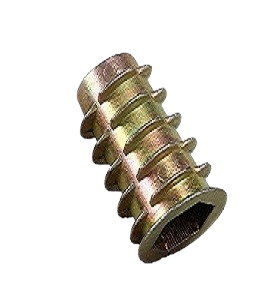
D-Nut Furniture Insert

Available In

Steel

Higher strength. Best for solid wood, hardwood and thick MDF with heavy loads.

Zinc Alloy

Decorative finish. Best for plywood, softwood and flat-pack particleboard.

What Is a D-Nut?

A D-Nut — also known as a Type D insert nut, screw-in insert nut or wood threaded insert — is a self-tapping fastener designed to create a strong, permanent and reusable internal machine thread inside wood, MDF, plywood and particleboard. Unlike a wood screw which threads directly into the wood fibres and weakens with repeated assembly, a D-Nut installs once and provides a durable metal thread that accepts a standard machine bolt or joint connector bolt as many times as needed without stripping.

The flanged head on the D-Nut serves two critical functions — it prevents the insert from being driven in too deep, and it distributes the clamping load over a wider surface area, preventing splitting around the hole in the wood panel. This makes the D-Nut the preferred fastener for knock-down furniture, flat-pack furniture, cabinet assembly, bed frames and any wood structure that requires repeated disassembly and reassembly.

Available Sizes

D-Nuts are available in M4 to M10 thread sizes. Select your size based on the machine bolt or joint connector bolt you are using — the internal thread of the D-Nut must match the bolt thread exactly. Always drill a pilot hole 0.1–0.2 mm smaller than the outer diameter of the D-Nut for the best grip and pull-out resistance.

Thread Size Common Use Typical Application Material
M4 Small panels, lightweight frames Thin MDF, shelf brackets Mild Steel
M5 Cabinet doors, small drawers Plywood, particleboard Mild Steel
M6 Most common furniture size Wardrobes, cabinets, beds, tables Mild Steel
M8 Structural joins, heavy panels Bed frames, heavy shelving Mild Steel
M10 Heavy-duty structural joints Workshop benches, heavy frames Mild Steel

How to Install a D-Nut — 4 Steps

1

Drill the Pilot Hole

Drill a pilot hole slightly smaller than the outer diameter of the D-Nut — typically 0.1 to 0.2 mm smaller. In softwood and MDF, a tighter fit gives better pull-out resistance. Make the hole at least as deep as the length of the D-Nut.

2

Position the D-Nut

Place the D-Nut over the pilot hole with the flanged head facing outward. Keep it perfectly vertical — an angled entry will misalign the internal thread and weaken the connection. Use a rubber mallet for hammer-in types.

3

Drive It In

For screw-in types, use an Allen key or flat-blade screwdriver to turn the D-Nut into the wood. The external self-tapping thread cuts into the wood fibres as it turns. Stop when the flange sits flush with the panel surface — do not over-drive.

4

Bolt & Assemble

Thread your machine bolt or joint connector bolt into the installed D-Nut. The internal metal thread accepts the bolt cleanly and holds it firmly. The joint can be tightened, loosened and reassembled repeatedly without any thread stripping.

Where Is the D-Nut Used?

🛏️

Bed Frames

Headboards, side rails, slat supports

🚪

Wardrobes

Side panels, shelves, door frames

🪑

Tables & Chairs

Leg joints, apron connections

📦

Flat-Pack Furniture

RTA furniture, knock-down assemblies

D-Nut vs Direct Wood Screw — Why Use an Insert?

Direct Wood Screw

Threads into wood fibres

Wood screws thread directly into the wood. Each time the joint is disassembled and reassembled, the wood fibres around the hole are gradually stripped — after 3 to 5 cycles the connection becomes loose and unreliable. Not suitable for furniture that needs to be moved or reassembled.

Strips after repeated assembly · Cannot be restored

D-Nut Insert

Permanent metal thread in wood

The D-Nut installs once and creates a permanent metal thread inside the wood. The machine bolt engages clean metal threads every time — the wood itself is never touched by the bolt again. The joint can be assembled and disassembled indefinitely with no loss of holding power.

Reusable indefinitely · No stripping · Professional finish

Quick Specifications

M4–M10

Thread Sizes

Mild Steel

Material

Golden

Finish

Flanged

Head Type

Installation Tips

  • Always drill a pilot hole first — never try to force a D-Nut into solid wood without one.
  • Keep the D-Nut perfectly vertical during installation — a tilted insert will cause bolt misalignment and uneven clamping.
  • Stop driving when the flange is flush with the panel surface — over-driving compresses the wood and reduces pull-out resistance.
  • For MDF and particleboard, use a slightly tighter pilot hole for maximum grip — these materials have lower holding strength than solid wood.
  • Do not overtighten the bolt after assembly — this can crack the wood around the insert, especially in thinner panels.

Frequently Asked Questions

What is a D-Nut and what is it used for?

A D-Nut is a self-tapping flanged insert nut designed to create a permanent machine thread inside wood, MDF, plywood and particleboard. It is screwed or hammered into a pre-drilled hole and provides a durable internal thread that accepts standard machine bolts. It is primarily used in knock-down furniture, flat-pack furniture, bed frames, wardrobes and cabinet assembly — anywhere a strong, reusable threaded connection in wood is needed.

What is the difference between a D-Nut and a T-Nut?

Both provide threaded holes in wood, but they install differently. A T-Nut has a flat flange with protruding prongs that dig into the wood surface — it is hammered in from the front and requires the bolt to pull it from the opposite side to seat it. A D-Nut is self-tapping with external threads — it screws directly into a pilot hole from the front and is fully self-locking. D-Nuts are generally preferred for enclosed panel furniture because they do not require access to both faces of the panel.

What size pilot hole do I need for a D-Nut?

The pilot hole should be 0.1 to 0.2 mm smaller than the outer diameter of the D-Nut. For softer materials like MDF and particleboard, err on the tighter side for better pull-out strength. For hardwood, a slightly looser fit makes installation easier without significantly reducing holding power. The hole depth should equal the length of the D-Nut or slightly deeper.

Can D-Nuts be used in MDF and particleboard?

Yes — D-Nuts work well in MDF and particleboard and are widely used in flat-pack furniture made from these materials. The self-tapping external thread grips the compressed wood fibres effectively. The flanged head is especially important in MDF, as it prevents the insert from sinking too deep into the softer surface material. Use a pilot hole at the tighter end of the tolerance range for best results in MDF.

Do you supply D-Nuts in bulk across India?

Yes. Excel Trading Corporation stocks D-Nut insert nuts in M4 to M10 at our Bengaluru store and supplies to furniture manufacturers, carpenters, contractors and hardware retailers across India. Call +91-9448239476 or use the Enquire Now button for pricing and bulk availability.