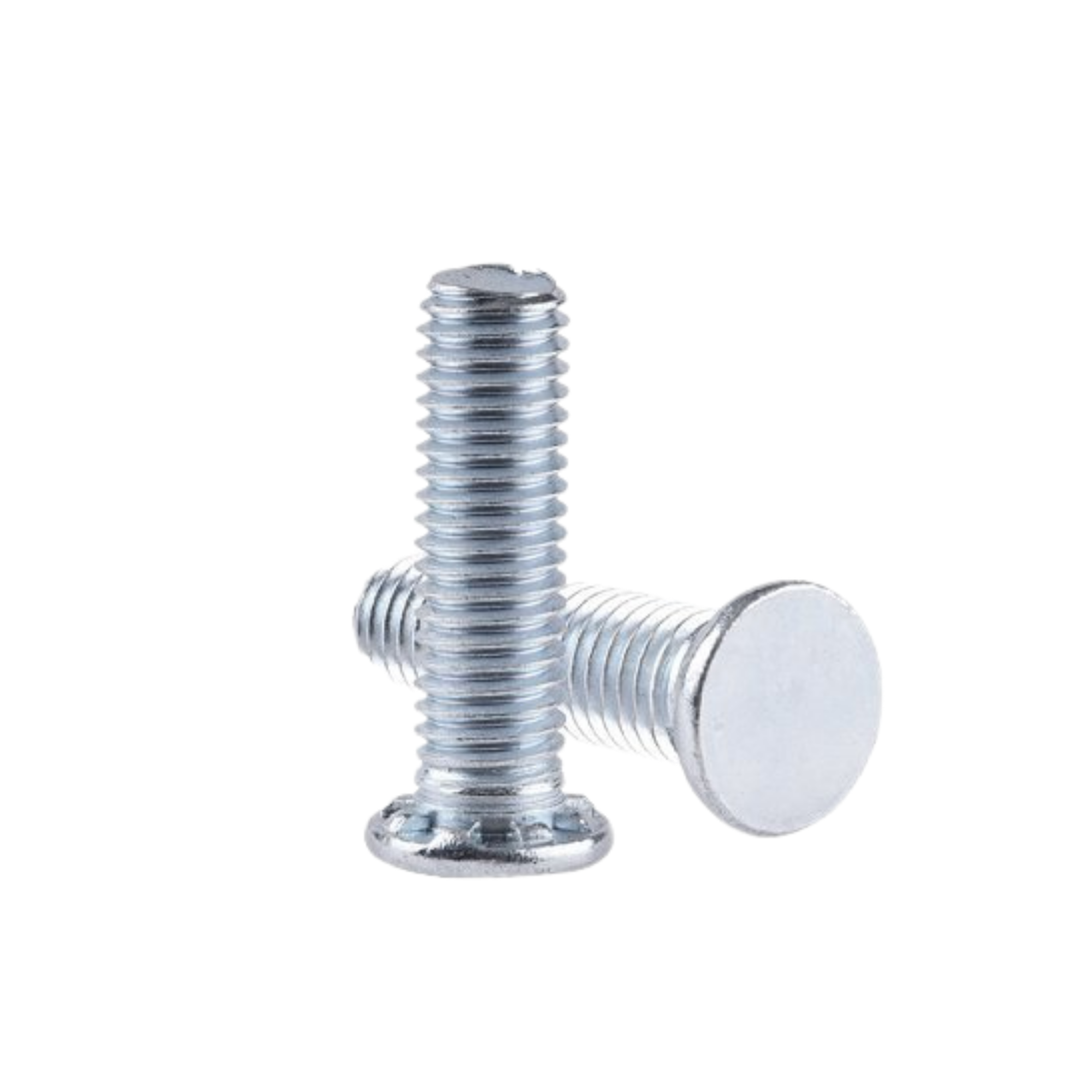
PEM FH-Type & FHS-Type · M3 to M8 · Zinc Plated & Stainless Steel
The self clinching stud — also called a press stud or clinch stud — provides a permanent external (male) thread projecting from a thin sheet metal panel. When pressed into a punched hole, the stud's head embeds flush into the sheet surface while the panel material cold-flows into an annular undercut groove, locking it permanently against push-out and rotation. Only the threaded shank projects from the reverse side — creating a fixed bolt post from which nuts, spacers, PCBs or panel covers can be fastened. Excel Trading Corporation stocks two types: the FH-type equivalent in heat-treated carbon steel (zinc plated, ASTM B633) and the FHS-type equivalent in 300-series stainless steel, in M3 through M8. Note: the sheet must be at least as thick as the stud's head embed depth (H dimension) — 4.6mm for M3, 5.9mm for M4, 6.5mm for M5, 8.2mm for M6, and 9.6mm for M8.
Zinc
Stainless Steel
FH-type (zinc plated carbon steel) available in all sizes M3 to M8. FHS-type (stainless steel) M3 to M6 only — M8 is FH-type only. Minimum sheet thickness equals the H dimension for each size.
The self clinching stud is the male-thread counterpart to the clinch nut. Where a clinch nut gives you a threaded hole in the panel that a bolt screws into, the clinch stud gives you a fixed threaded post projecting from the panel that a nut tightens onto. This makes it the correct choice when you need to attach something — a PCB, a cover plate, a standoff — to the panel by threading a nut from outside, or when you need a registration pin that locates a component accurately before fastening.
Once pressed in, the stud head embeds fully flush into the front face of the panel. There is nothing to snag, scratch or protrude on the entry side. The threaded shank projects cleanly from the back — ready for a nut, a spacer, or a PCB mounting hole to thread onto it. The critical rule throughout is differential hardness: the stud must always be harder than the host sheet. If the sheet is too hard, the annular undercut cannot lock and push-out resistance will be near zero.
Zinc Plated (ASTM B633) · Standard Grade · M3 to M8
Heat-treated carbon steel with zinc plating to ASTM B633. The standard choice for server chassis, electronics enclosures, switchboards, telecom hardware and general precision fabrication. Works in steel and aluminium panels up to HRB 80 / HB 150. The hardest of the two stocked types — gives the highest cold-displacement force and the best push-out values.
Best for: Electronics, control panels, server chassis, automotive brackets — indoor and dry environments. Available M3 to M8.
Passivated · Corrosion Resistant · M3 to M6 only
300-series austenitic stainless steel, passivated. Fully corrosion resistant in wet, coastal and chemical environments. Because 300-series stainless is softer than heat-treated carbon steel, FHS-type works only in softer panels — maximum sheet hardness HRB 70 / HB 125. Standard cold-rolled mild steel typically falls within this limit.
Best for: Outdoor telecom cabinets, coastal installations, food processing panels, marine enclosures. M3 to M6 only — M8 requires FH-type.
Neither FH nor FHS — FH4-type required
Stainless steel panels are typically HRB 90 or harder — exceeding the limit for both FH-type and FHS-type studs. Attempting to install either type into stainless sheet will result in near-zero push-out resistance. A specially hardened FH4-type stud (hardened 400-series stainless) is required for stainless steel host panels.
Contact us on +91-9448239476 if your panels are stainless steel — we can advise on the correct specification.
The clinch stud and clinch nut are complementary products. The right choice depends on whether you want a fixed post projecting from the panel, or a threaded hole recessed into it.
The clinch stud works through controlled cold-forming of the host sheet — the same principle as the clinch nut, but in reverse orientation. The stud has a flat head with a serrated clinching ring on its underface, and an annular undercut groove between the ring and the cylindrical body. When pressed into a punched hole, the head is driven flush into the panel surface. As the press stroke closes, the clinching ring bites into the sheet and the panel material at the hole edge is forced radially inward and downward into the undercut groove — permanently locking the stud against pull-out.
The result is a stud whose head is fully embedded flush on the panel's entry face, while the threaded shank projects cleanly from the reverse side. The serrated ring prevents rotation when a nut is tightened onto the shank. The critical requirement throughout is differential hardness — if the panel material is too hard, the ring cannot displace enough material into the undercut and push-out resistance will be near zero.
Example: FH-M4-10ZI
Self clinching studs must be installed by squeezing force — a bench press, C-frame press, hydraulic or pneumatic press with flat anvils. The press must apply force perpendicular to the sheet surface. Never use a hammer or impact tool; uneven force will cock the stud or crack the panel.
For best results, install from the punch side — the face from which the hole was punched. The punch side has a clean, sharp entry which mates correctly with the stud's undercut. The die side may have a slight burr which can interfere with the clinching ring seating.
Install into bare, uncoated sheet — always
Never install self clinching studs into painted or powder-coated panels. Coating fills the mounting hole and the undercut groove — the sheet metal cannot cold-flow and push-out resistance will be near zero. Install into bare sheet metal first, then carry out any painting, powder coating or plating on the full assembly. Also — never deburr or chamfer the mounting hole. Deburring removes the material that must flow into the undercut.
A self clinching stud provides a permanent external male thread projecting from a sheet metal panel. It is pressed into a punched hole by a squeezing force. The sheet metal cold-flows into the stud's annular undercut groove, locking it permanently with high push-out and torque-out resistance. A serrated clinching ring prevents rotation when a nut is tightened onto the shank. The head embeds fully flush into the panel entry face — only the threaded shank projects from the reverse side. No welding, heat or adhesive required.
FH-type studs are heat-treated carbon steel with zinc plating (ASTM B633) — the standard choice for electronics, server chassis and general fabrication. They work in steel and aluminium panels up to HRB 80 / HB 150 and are available in M3 to M8. FHS-type studs are 300-series stainless steel — fully corrosion resistant but softer, working only in panels up to HRB 70 / HB 125. FHS-type is available M3 to M6 only — M8 is FH-type only. Choose FHS-type when the fastener itself must resist corrosion in outdoor, wet or coastal environments.
Minimum sheet thickness equals the H dimension — the stud's head embed depth. The values are: M3 = 4.6mm, M4 = 5.9mm, M5 = 6.5mm, M6 = 8.2mm, M8 = 9.6mm. The sheet must be at least as thick as the H dimension for the head to embed fully and develop adequate push-out resistance. Also ensure the panel hardness is within the limit for your chosen stud type — HRB 80 for FH-type, HRB 70 for FHS-type.
A clinch stud provides a permanent male (external) thread projecting from the panel — a nut is tightened onto it from outside. A clinch nut provides a permanent female (internal) thread recessed into the panel — a bolt screws into it from outside. Use a clinch stud when you want a fixed post that a component or cover threads onto. Use a clinch nut when you want a threaded hole that a removable bolt screws into repeatedly.
Paint and powder coating fill the mounting hole and the undercut groove where sheet metal must cold-flow to lock the stud. If coating is present, the metal cannot displace properly — push-out and torque-out resistance will be severely reduced or near zero. Always install self clinching studs into bare, uncoated sheet. If the panel will be painted or coated after fabrication, install the studs first, then coat the complete assembly.
Excel Trading Corporation stocks PEM FH-type and FHS-type equivalent clinch studs in M3, M4, M5, M6 and M8 at our Kumbarpet store in Bengaluru. We supply across Karnataka, Tamil Nadu, Andhra Pradesh, Telangana, Kerala and India-wide. Call +91-9448239476 or email info@exceltrading.in for pricing and availability.