Head types, drive types and grade markings explained — plus hex flange bolts in stock. Trusted by fabricators and engineers across India.
Head type determines how load is transferred to the clamped surface, whether the fastener sits flush or proud, and what tool is needed to drive it. Choosing the wrong head type is a common cause of assembly rework and premature joint failure.
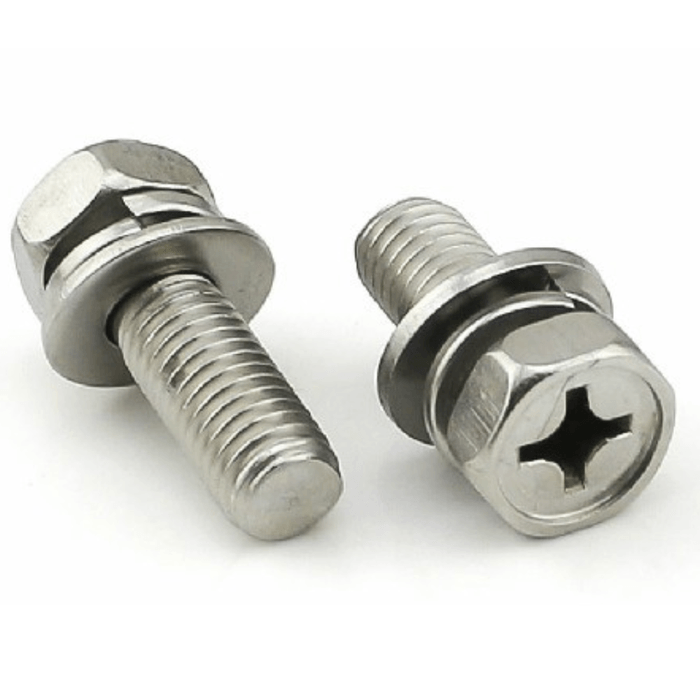
Hexagonal head driven with a spanner or socket for maximum driving torque. The standard head for structural, machinery and general engineering bolting wherever a separate washer can be used.
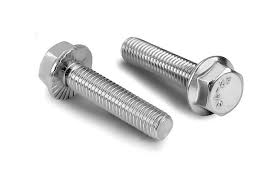
A hex head with an integrated flange in place of a separate washer — spreads clamp load, speeds up assembly and removes one loose part from the bill of materials. See our Hex Flange Bolt (DIN 6921) page for full specifications.
Used mainly on smaller machine and self tapping screws — pan for general purpose, countersunk for a flush finish, truss for a wide, low-profile bearing surface on soft materials.
The number stamped on a bolt head — such as 8.8, 10.9 or 12.9 — is its property class, a strength rating standardised internationally. The first number, multiplied by 100, gives the approximate minimum tensile strength in MPa. The second number is the yield-to-tensile ratio multiplied by 10.
Important Selection Rule
A higher grade is not automatically "better" — it must be matched to the nut grade, the joint's torque specification and the base material. A high-grade bolt in soft base material can pull the threads out of the parent metal before the bolt itself yields. Confirm your joint's full specification, not just the bolt grade, before ordering.
General-purpose, widely available, low cost. Prone to cam-out at high torque — not ideal for power-driven high-torque assembly.
Simple, cheap, easy to clean. Poor cam-out resistance and low torque transfer — mostly low-torque or decorative use.
Highest torque transfer of the common drive types. Standard for structural bolting and machinery assembly.
Excellent cam-out resistance, ideal for automated and power tool assembly. Increasingly common in automotive and electronics.
The economical default for indoor, dry or sheltered environments. Adequate corrosion protection for general fabrication, machinery and construction fixings.
The correct choice for outdoor, humid or mildly corrosive environments — resists rust and oxidation through monsoon conditions and general industrial atmospheres.
Required for coastal, marine or aggressive chemical exposure — the added molybdenum content gives superior resistance to chloride-based corrosion.
The two numbers are the property class. The first number x100 gives the approximate minimum tensile strength in MPa (8.8 = 800 MPa, 10.9 = 1000 MPa, 12.9 = 1200 MPa). The second number is the yield-to-tensile ratio x10 (8.8 = yield is 80% of tensile). Together they tell you both how strong the bolt is and how much it deforms before yielding.
Grade 8.8 covers the large majority of general fabrication, machinery and construction bolting. Grade 10.9 is specified where a joint carries high preload or high shear/tensile load in a compact space — structural steel connections, engine and suspension mounts, and critical machinery joints.
A standard hex bolt has a plain hexagonal head and needs a separate flat washer. A hex flange bolt has an integrated flange forged into the head, combining bolt and washer into one part — faster assembly, no washer to lose, and a guaranteed, concentric bearing surface every time.
Phillips is the general-purpose default. Hex socket gives the highest torque transfer and is standard for structural bolting. Torx offers excellent cam-out resistance for power tool assembly. Match the drive type to your torque requirement and assembly method, not just cost.
Zinc plated mild steel is the economical choice for indoor, dry or sheltered environments. Stainless steel A2 (SS304) is required for outdoor or humid conditions. A4 (SS316) is needed for coastal, marine or aggressive chemical exposure.
Excel Trading Corporation stocks hex flange bolts and a wide range of screws and bolts at our store — 163, Sadar Patrappa Rd, Kumbarpet, Bengaluru 560002. We supply across Karnataka and India. Call +91 7204435253 or email info@exceltrading.in for pricing and availability.